NX-RS[][][][]
NX-series Load Cell Input Unit
![NX-RS[][][][]](/Images/l_3538-21-263044-198x198.jpg)
Build a cost saving weighing/ measurement system by using load cells
Related Contents
 Application Solutions
- Features
- Lineup
- Specifications
- Dimensions
- Catalog / Manual / CAD / Software
last update: February 6, 2020
General Specification
| Item | Specification | |
|---|---|---|
| Enclosure | Mounted in a panel | |
| Grounding methods | Ground of 100 Ω or less | |
| Operating
environment |
Ambient operating
temperature |
0 to 55°C |
| Ambient operating
humidity |
10 to 95% RH (with no icing or condensation) | |
| Atmosphere | Must be free from corrosive gases. | |
| Ambient storage
temperature |
-25 to 70°C (with no icing or condensation) | |
| Altitude | 2,000 m max. | |
| Pollution degree | Pollution degree 2 or less: Meets IEC 61010-2-201. | |
| Noise immunity | Conforms to IEC 61000-4-4, 2 kV (power supply line) | |
| Overvoltage
category |
Category II: Meets IEC 61010-2-201. | |
| EMC immunity level | Zone B | |
| Vibration resistance | Conforms to IEC 60068-2-6.
5 to 8.4 Hz with amplitude of 3.5 mm, 8.4 to 150 Hz, acceleration of 9.8 m/s2 100 min each in X, Y, and Z directions (10 sweeps of 10 min each = 100 min total) |
|
| Shock resistance | Conforms to IEC 60068-2-27, 147 m/s2, 3 times each in X, Y, and Z directions | |
| Applicable standards * | cULus: Listed (UL61010-2-201), ANSI/ISA 12.12.01, EU: EN 61131-2, NK, LR,
RCM, KC: KC Registration |
|
* Ask your OMRON representative for the most recent applicable standards for each model.
Function Specification
Supported: Functions that are used in target applications
-: Functions that are not used in target applications
| Function | Application | Description | ||
|---|---|---|---|---|
| Weight
measurement *1 |
Force
measurement *2 |
|||
| I/O refreshing
ethod setting *3 |
Supported. | Supported. | Sets Free-Run refreshing, synchronous I/O refreshing,*4 or task
period prioritized refreshing*5 for the I/O refreshing*6 method. |
|
| Actual load
calibration |
Supported. | Supported. | This is a user calibration function that is performed by placing an
actual load on the load cell. |
|
| Equivalent input
calibration |
Supported. | Supported. | This is a user calibration function that is performed by inputting
the rated output, rated capacity, and zero balance values of the load cell. |
|
| Gravity
acceleration correction |
Supported. | - | This function corrects errors in the gross weight values that occur
due to the difference of gravity acceleration at each site when the site where the actual load calibration of the device is executed and the installation site are different. |
|
| Digital filtering | Supported. | Supported. | This function uses the digital filter to remove noise components
that are contained in input signals to suppress fluctuations of measurement values. You can use the digital low-pass filter and moving average filter. |
|
| Zero set/
zero reset |
Supported. | Supported. | The zero set function corrects the gross weight value/force
measurement value to be the zero point within the set range at a desired time. The zero reset function resets the zero point correction that is performed with the zero set function. |
|
| Zero tracking | Supported. | - | This function automatically corrects the zero point within the set
range. |
|
| Zero point range
over detection |
Supported. | Supported. | This function detects when the gross weight value/force
measurement value exceeds the set zero point range. |
|
| Tare subtraction | Supported. | - | This function subtracts the tare weight value from the gross weight
value to acquire the net weight value. There are two types of this function: one-touch tare subtraction and digital tare subtraction. |
|
| One-touch tare
subtraction |
Supported. | - | This function stores the gross weight value at the specified timing
as the tare value and subtracts it from a given gross weight value to acquire the net weight value. |
|
| Digital tare
subtraction |
Supported. | - | This function subtracts the preset digital tare value from the gross
weight value to acquire the net weight value. |
|
| Stable detection | Supported. | - | This function detects whether the gross weight value is stable. | |
| Over range/under
range detection |
Supported. | Supported. | This function detects when the input signal exceeds the input
conversion range. |
|
| Sensor
disconnection test |
Supported. | Supported. | This function tests if the cable that connects the Load Cell Input
Unit and load cell is disconnected. During the sensor disconnection test, you cannot measure the weight or force. |
|
| Input value
refreshing stop |
Supported. | Supported. | This function stops refreshing the input value in a specified period. | |
| Peak hold/
bottom hold |
- | Supported. | This function continues holding the peak value or the bottom
value of the force measurement value in a specified period. |
|
| Data tracing | Supported. | Supported. | This function records the values in REAL data in the buffer of the
Load Cell Input Unit and exports the data to a CSV file. These values indicate the gross weight values/force measurement values before and after the digital filtering in a specified period. |
|
| Decimal point
position setting |
Supported. | Supported. | This function sets the number of digits which is displayed after the
decimal point for each DINT data. |
|
*1. It is used to measure the weight in the unit of kg or t.
*2. It is used to measure the force in the unit of N or kN.
*3. Select with the Communications Coupler Unit setting. Refer to the NX-series Load Cell Input Unit User’s Manual
(W565) for details on the setting method.
*4. You can select this option only when the Unit is used with an EtherCAT Coupler Unit with EtherCAT communications
in DC Mode.
*5. You can select this option only when the Unit is used with an EtherCAT Coupler Unit NX-ECC203 with EtherCAT
communications in DC Mode.
*6. This is the data exchange with the Controller.
Individual Specifications
Load Cell Input Unit
NX-RS1201
| Unit name | Load Cell Input Unit | Model | NX-RS1201 | |
|---|---|---|---|---|
| Number of points | 1 point | External connection
terminals |
Screwless clamping terminal block
(16 terminals) |
|
| I/O refreshing
method |
Free-Run refreshing, synchronous I/O refreshing, or task period prioritized refreshing | |||
| Indicators | TS indicator
 |
Input range | -5.0 to 5.0 mV/V | |
| Input conversion
range |
-5.5 to 5.5 mV/V | |||
| Load cell excitation
voltage |
5 VDC ± 10%, Output current:
60 mA max. |
|||
| Zero point adjustment
range |
-5.0 to 5.0 mV/V | |||
| Gain point adjustment
range |
-5.0 to 5.0 mV/V | |||
| Accuracy
*1 |
Nonlinearity | ±0.01% (full scale) *2 | ||
| Zero drift | ±0.1 μV/°C RTI | |||
| Gain drift | ±10 ppm/°C | |||
| A/D converter
resolution |
24 bits | |||
| Warm-up period | 30 minutes | Conversion cycle | 125 μs | |
| Dimensions | 12 (W) × 100 (H) × 71 (D) | Isolation method | Between the input and the NX bus:
Power = Transformer, Signal = Digital isolator |
|
| Insulation
resistance |
20 MΩ min. between isolated
circuits (at 100 VDC) |
Dielectric strength | 510 VAC between isolated circuits
for 1 minute at a leakage current of 5 mA max. |
|
| I/O power supply
method |
No supply | Current capacity of I/O
power supply terminal |
Without I/O power supply terminals | |
| NX Unit power consumption | • Connected to a CPU Unit
2.05 W max. • Connected to a Communications Coupler Unit 1.70 W max. |
Current consumption
from I/O power supply |
No consumption | |
| Weight | 70 g max. | |||
| Circuit layout | 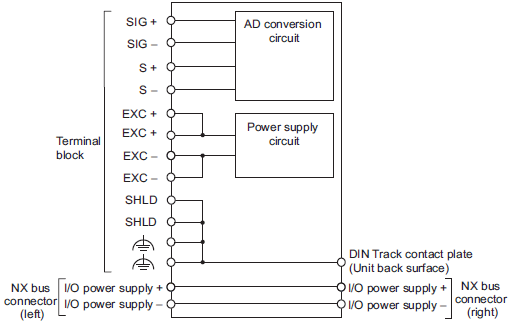 |
|||
| Installation
orientation and restrictions |
Installation orientation:
• Connected to a CPU Unit: Possible in upright installation. • Connected to a Communications Coupler Unit: Possible in 6 orientations. Restrictions: No restrictions |
|||
| Terminal
connection diagram |
Diagram of the 6-wire connection between the Unit and a load cell. 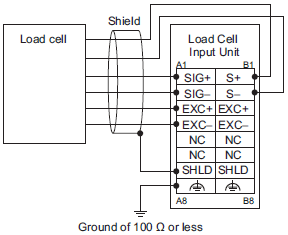
Diagram of the 4-wire connection between the Unit and a load cell. 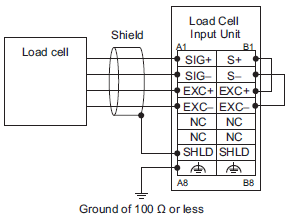 |
|||
*1. Accuracy for when the load cell and the Load Cell Input Unit are connected with the 6-wire connection.
*2. The value for when the Load Cell Unit is used under the following conditions.
Full scale: 0.0 to 5.0 mV/V or -5.0 to 0.0 mV/V
Ambient temperature: 25°C
Setting of digital filtering: Default
Version Information
Connecting with CPU Units
Refer to the user's manual for the CPU Unit for the CPU Unit to which NX Units can be connected.
| NX Unit | Corresponding unit versions/versions | ||
|---|---|---|---|
| Model | Unit version | CPU Unit | Sysmac Studio |
| NX-RS1201 | Ver.1.0 | Ver.1.13 | Ver.1.17 |
Note: Some Units do not have all of the versions given in the above table. If a Unit does not have the specified version,
support is provided by the oldest available version after the specified version. Refer to the user’s manuals for the
specific Units for the relation between models and versions.
support is provided by the oldest available version after the specified version. Refer to the user’s manuals for the
specific Units for the relation between models and versions.
Connecting with an EtherCAT Coupler Units
| NX Unit | Corresponding unit versions/versions | |||
|---|---|---|---|---|
| EtherCAT | ||||
| Model | Unit version | EtherCAT Coupler Unit | CPU Units or Industrial PCs | Sysmac Studio |
| NX-RS1201 | Ver.1.0 | Ver.1.0 | Ver.1.05 | Ver.1.16 |
Note: Some Units do not have all of the versions given in the above table. If a Unit does not have the specified version,
support is provided by the oldest available version after the specified version. Refer to the user’s manuals for the
specific Units for the relation between models and versions.
support is provided by the oldest available version after the specified version. Refer to the user’s manuals for the
specific Units for the relation between models and versions.
Connecting with EtherNet/IP Coupler Unit
| NX Unit | Corresponding unit versions/versions | ||||||
|---|---|---|---|---|---|---|---|
| Application with an NJ/NX/NY-series
Controller *1 |
Application with a CS/CJ/CP-series
PLC *2 |
||||||
| Model | Unit version | EtherNet/IP
Coupler Unit |
CPU Unit or
Industrial PC |
Sysmac
Studio |
EtherNet/IP
Coupler Unit |
Sysmac
Studio |
NX-IO
Configurator *3 |
| NX-RS1201 | Ver. 1.0 | Ver. 1.2 | Ver. 1.14 | Ver. 1.19 | Ver. 1.0 | Ver. 1.16 | Ver. 1.00 |
Note: Some Units do not have all of the versions given in the above table. If a Unit does not have the specified version,
support is provided by the oldest available version after the specified version. Refer to the user's manuals for the
specific Units for the relation between models and versions.
*1. Refer to the user’s manual for the EtherNet/IP Coupler Units for information on the unit versions of EtherNet/IP Units
that are compatible with EtherNet/IP Coupler Units.
*2. Refer to the user’s manual for the EtherNet/IP Coupler Units for information on the unit versions of CPU Units and
EtherNet/IP Units that are compatible with EtherNet/IP Coupler Units.
*3. For connection to an EtherNet/IP Coupler Unit with unit version 1.0, You can connect only to the peripheral USB port on
the EtherNet/IP Coupler Unit. You cannot connect with any other path. If you need to connect by another path, use an
EtherNet/IP Coupler Unit with unit version 1.2 or later.
support is provided by the oldest available version after the specified version. Refer to the user's manuals for the
specific Units for the relation between models and versions.
*1. Refer to the user’s manual for the EtherNet/IP Coupler Units for information on the unit versions of EtherNet/IP Units
that are compatible with EtherNet/IP Coupler Units.
*2. Refer to the user’s manual for the EtherNet/IP Coupler Units for information on the unit versions of CPU Units and
EtherNet/IP Units that are compatible with EtherNet/IP Coupler Units.
*3. For connection to an EtherNet/IP Coupler Unit with unit version 1.0, You can connect only to the peripheral USB port on
the EtherNet/IP Coupler Unit. You cannot connect with any other path. If you need to connect by another path, use an
EtherNet/IP Coupler Unit with unit version 1.2 or later.
last update: February 6, 2020
 Top of page